Single Point of Failure

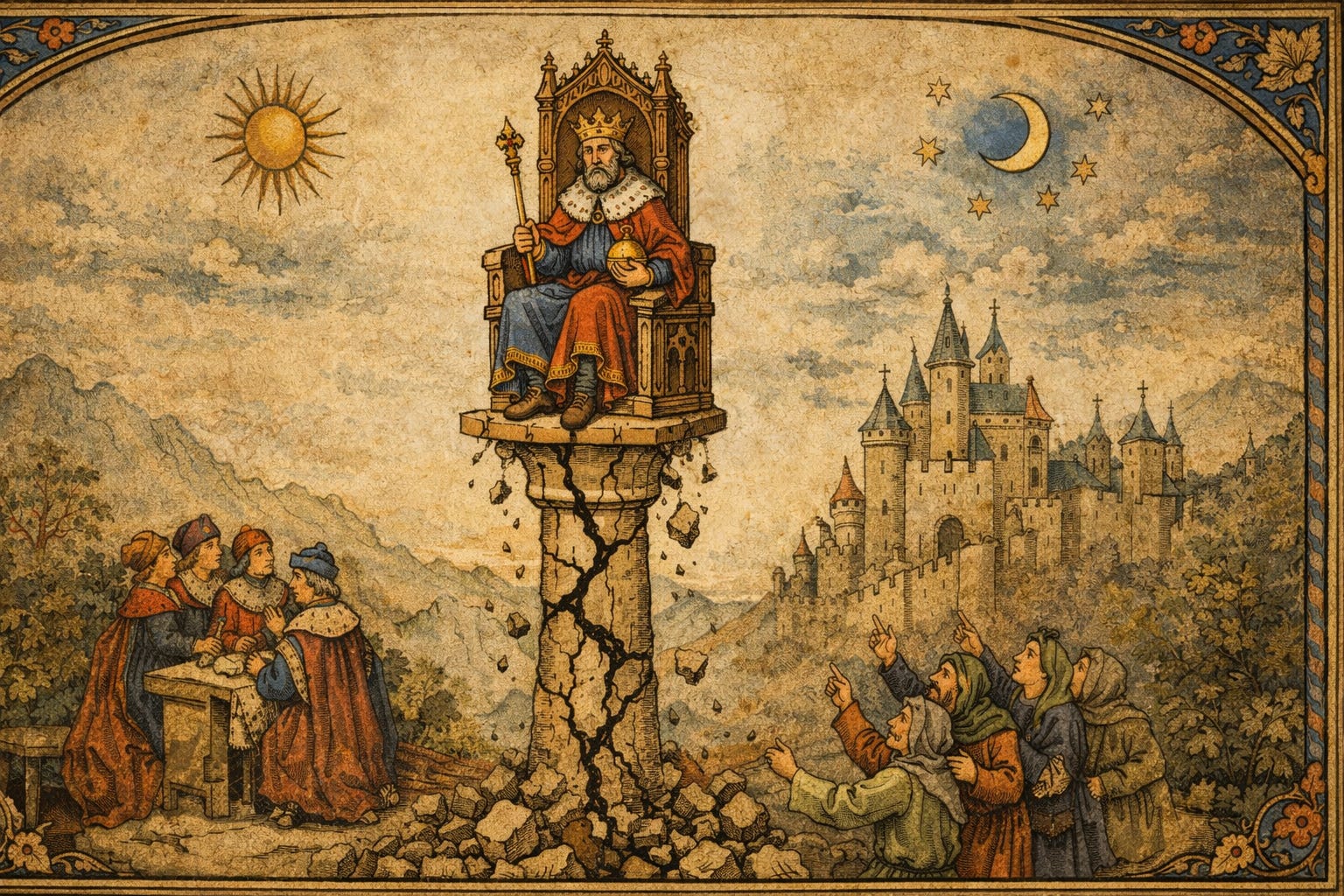
There is something almost paradoxical in how we design power. In technical systems we instinctively avoid single points of failure; we build redundancy into bridges, we duplicate sensors in chemical plants, we distribute load in networks because we know that concentration increases fragility. And yet, when it comes to politics and corporations, we repeatedly construct arrangements in which enormous leverage sits in very few hands — sometimes in one — and then we behave as if instability were an unfortunate accident rather than a predictable structural feature.
It is comforting to tell ourselves that the problem is personality. That if only a wiser, calmer, more ethical individual occupied the top position, everything would function as intended. But this explanation quietly protects the architecture. It turns systemic risk into biography and allows the structure to remain unquestioned.
I have sat in senior management rooms where the structure revealed itself in small, almost aesthetic details, sometimes before a word was even spoken. The table polished to a shine, the language refined, the slides immaculate, the numbers obedient inside their coloured frames. Outside those rooms — in the plant, in the corridors, in informal conversations — people sensed accumulating tensions. They saw operational cracks, cultural fatigue, strategic blind spots. Inside the room, those signals seemed to lose density. Questions were rephrased into alignment. Concerns were softened into suggestions. Nobody wanted to be the asymmetry in an otherwise harmonious picture, and after learning the hard way: least of all me (I was younger then). Over time the organisation began believing its own presentation of itself, not because anyone consciously lied, but because concentrated authority naturally reshapes the flow of information.
When authority concentrates, information adapts. When information adapts, reality becomes selective. And when selectivity persists for long enough, correction becomes very expensive.
The usual defence of this arrangement is that coordination requires hierarchy (“functional hierarchy”), that speed requires a decisive centre, that someone must ultimately decide. In Germany (…) they even have a phrase for this: “einer muss den Hut auf haben.” Coordination, however, is a function; concentration is a design choice. The two are not identical, even if we habitually treat them as such.
If you observe how healthy teams actually operate, especially in technically demanding environments, you often see something more fluid. Responsibility shifts depending on competence and context. The person leading at one moment steps back at the next. Authority feels less like ownership and more like load-bearing that circulates. The difficulty begins when the front position stops being a role and hardens into identity, when climbing becomes the dominant activity and the structure starts selecting for those most skilled at navigating it.
Steep hierarchies filter. They reward impression management, narrative compression, and loyalty signalling because these are the tools that allow survival during ascent. By the time someone reaches the summit, they inhabit an increasingly narrow informational channel – a kind of padded tunnel where most sharp edges have been removed (see my “Managing Upwards” article). The higher the position, the more curated the signals. Dissent begins to resemble disloyalty; ambiguity begins to resemble weakness. None of this requires malicious intent. It emerges from the geometry of the system.
From there it is not a large conceptual leap to the ecological layer, although it should not be treated as a decorative analogy. In ecosystems resilience arises from distributed sensing and distributed response. Forests do not rely on a single organism to interpret drought signals; soils do not centralize intelligence; feedback loops are embedded laterally as well as vertically. Diversity does not merely increase beauty, it increases error-correction capacity.
Modern civilisation, by contrast, has been busy centralizing both energy and authority. We extract concentrated fossil energy, convert it into economic throughput. We accumulate capital in narrowing nodes, and compress decision-making into smaller circles. And our financial systems consolidate, the political institutions centralize executive power and digital platforms aggregate data and influence at planetary scale. Meanwhile the distributed intelligence of the biosphere — the soils, forests, microbial systems that quietly regulate climate and fertility — is degraded. Fast and almost beyond recovery.
If we redefine civilisational maturity not as energy consumption but as the ability to circulate energy through living systems without eroding them, then our current trajectory appears less like advancement and more like overconcentration. From a thermodynamic perspective, concentration without proportional feedback increases fragility. When corrective signals weaken while pressure increases, the amplitude of failure grows.
This is why steep hierarchies concern me beyond partisan politics. A civilisation that narrows authority while overshooting ecological limits is effectively building layered single points of failure. A miscalculation at a central node can cascade widely because the system has reduced its own capacity to sense and respond. Overshoot becomes visible only when correction is already costly.
None of this implies that structure should dissolve into perpetual consensus. Hierarchies will always emerge, and informal power will always form if formal governance disappears. The meaningful distinction is not between hierarchy and flatness, but between visible, correctable authority and insulated, self-reinforcing authority. Resilient systems deliberately embed countervailing forces, rotate high-load roles, separate powers that should not cohabit, and protect channels through which uncomfortable information can travel.
Steep hierarchy seduces because it simplifies complexity into a face and a voice. It offers clarity in anxious times. It reduces noise. Yet it optimises for throughput rather than for truth. In a polycrisis context defined by ecological overshoot, technological acceleration, and geopolitical volatility, truth becomes more valuable than speed.
Perhaps maturity — whether personal, organisational, or civilisational — consists less in producing extraordinary leaders and more in designing institutions that don’t need extraordinary virtue at the top. If stability rests on the character of a single individual, fragility is already built in – even if the table stays polished and the slides remain immaculate.